
Rotate Exercises Without Losing Muscle-Building Progress

 0
0
 0
0 Keep proven lifts long enough to improve, then rotate them only when progress, recovery, or joint comfort gives you a reason. To maximize gains with a smart exercise rotation strategy, keep the main movement patterns stable, train hard enough to count, eat enough to recover, and change one variable at a time. Constant novelty feels productive, but it usually makes progress harder to measure.
Last updated: 2026-08-10
Taylor Lautner’s film preparation shows why flashy claims need context. He reportedly gained 30 pounds of muscle between the first and second Twilight films, in a year, after previously being 5'10" and 140 pounds. He was a 17-year-old playing Jacob Black in New Moon, with trainer Jordan Yuam, the owner of Jordan’s Virtual Fit Club, who had over 20 years experience.
That does not prove that changing exercises constantly built the result. Film roles bring a deadline, coaching, food, recovery, and a level of daily focus most lifters do not have. Copying a celebrity workout while ignoring those conditions is cargo-cult training.
How do you maximize gains with a smart exercise rotation strategy?
Use exercise rotation to extend productive training, not to escape a lift before you’ve learned it. Keep a stable primary exercise, track your reps and load, and rotate only after you’ve gathered enough evidence that the current choice no longer serves you.
A smart rotation strategy has four jobs:
- Build skill through repeated practice.
- Keep the target muscle working hard.
- Limit joint irritation and unnecessary fatigue.
- Give you a clear way to measure progress.
The wrong approach changes the exercise, rep target, equipment, and training schedule at once. You may feel challenged, but you won’t know what improved or what caused the stall.
The right approach is simple on paper and demanding in practice. Keep the main lifts familiar, use close variations when needed, and let your logbook decide when a change is earned.
The priorities of a smart exercise rotation strategy
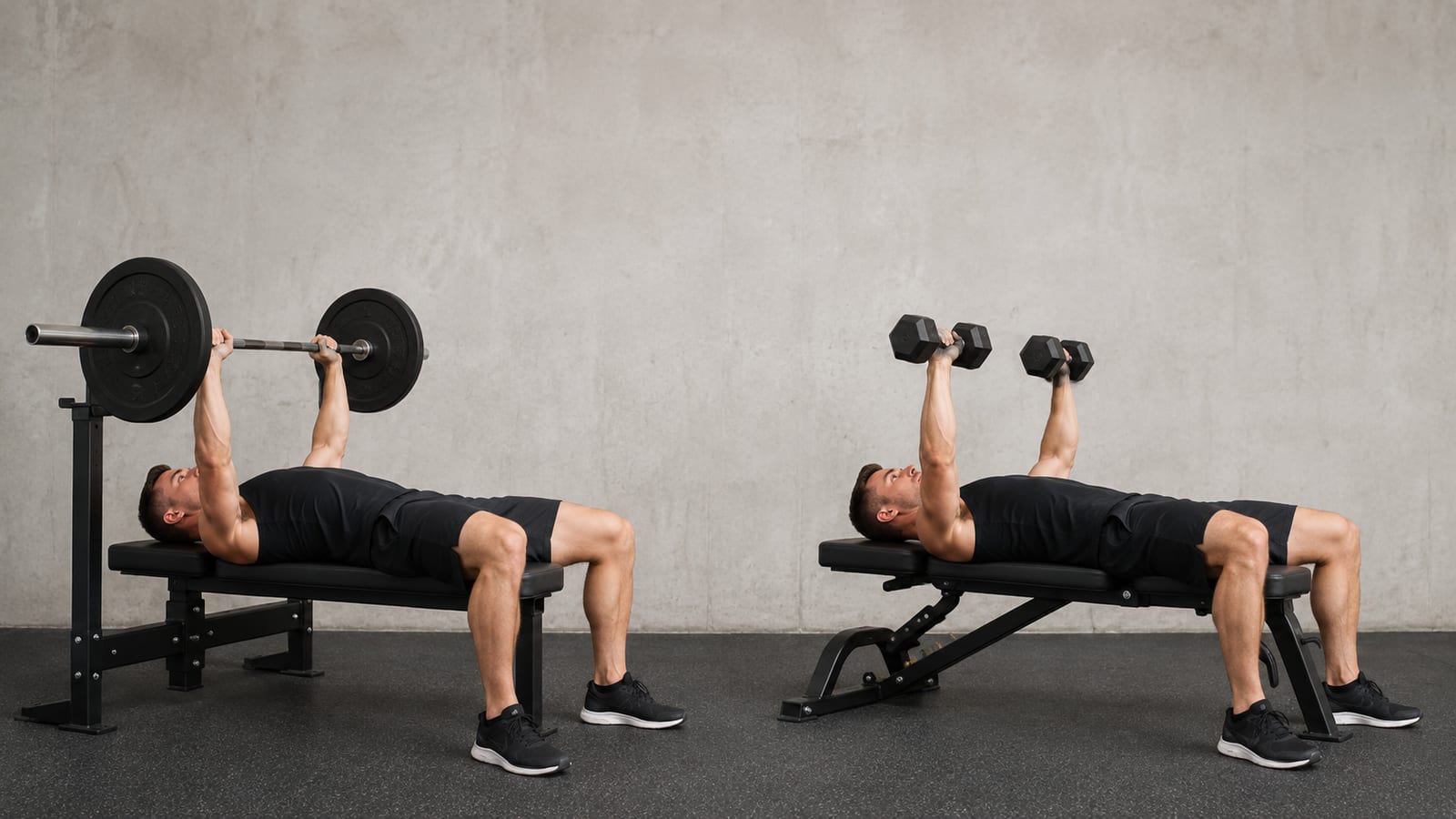
Exercise rotation means changing a movement while keeping the training goal intact. A barbell bench press, dumbbell press, and machine chest press are different tools for the same broad job. They are not interchangeable in every detail, but they can train the same pattern and muscle group.
Rotation should preserve these basics:
- The muscle or movement you’re trying to train.
- A stable range of motion.
- A technique you can repeat.
- A load or rep target you can track.
- Enough recovery to perform well again.
You don’t need a new exercise because a familiar one feels less exciting. You need a new exercise if the old one stops producing quality reps, causes joint trouble, or no longer fits your schedule.
This is also why chasing novelty is a poor planning principle. Muscles don’t need surprise. They need enough tension, repeated exposure, and a reason to adapt.
The right timeline for rotating an exercise
Keep an exercise through a sustained training block unless a clear problem appears sooner. You need enough repeated sessions to build skill, add reps or load, and judge your recovery. Dropping a lift after one poor workout tells you almost nothing.
Stay with the exercise while:
- Your technique is becoming more consistent.
- Your target muscle is doing the work.
- Your performance is stable or improving.
- Your joints feel normal during and after training.
- You can recover before the next exposure.
Rotate sooner if the movement causes sharp pain, your form breaks down despite sensible adjustments, or the exercise repeatedly disrupts the rest of your program.
Don’t confuse a slow week with a failed exercise. Poor sleep, low food intake, stress, or an overly ambitious workload can make a good lift look ineffective. Fix those conditions before blaming the movement.
A foundation for a limited-time routine
Build your routine around stable patterns that train large muscle groups with little setup. You should be able to repeat them, load them sensibly, and finish them without turning the session into a circus.
| Training goal | Reliable exercise categories | Useful close variations |
|---|---|---|
| Knee-dominant leg work | Squat or leg press | Front squat, split squat, hack squat |
| Hip-dominant leg work | Romanian deadlift or hip thrust | Good morning, back extension, cable pull-through |
| Horizontal pressing | Bench press or machine press | Dumbbell press, push-up |
| Vertical pressing | Overhead press | Dumbbell press, landmine press |
| Pulling | Row or pulldown | Chest-supported row, pull-up |
| Smaller muscle work | Curl, triceps extension, lateral raise, calf raise | Cable, dumbbell, or machine version |
Choose the version that lets you train with repeatable technique and hard enough effort. A machine isn’t inferior because it has more support. A barbell isn’t automatically better because it looks serious.
For a limited-time routine, use a small menu of movements. Pairing every possible variation with every muscle group creates setup time and fatigue without guaranteeing more growth. A three-day muscle-building workout gives you a better starting structure if your week is crowded.
Your joints get a vote. If a supported row trains your back better than a bent-over row, keep the supported row.
The progression order when progress stalls

Change one variable at a time. Start with the least disruptive option, then move toward a new exercise only if the simpler adjustment fails.
Use this order:
- Keep the exercise and add a rep within your planned range.
- Add a small amount of load when your technique and reps support it.
- Adjust the number of productive sets if recovery allows.
- Improve range of motion or control without changing the movement.
- Use a close variation that keeps the same training goal.
- Replace the exercise if it still fails the test.
You may rotate reps without rotating exercises. Heavy work can suit a stable compound lift, while moderate or higher reps often work better for curls, lateral raises, and leg extensions. The best range is the one that lets the target muscle work hard without making technique fall apart.
Jordan Yuam reportedly recommended about 40 percent heavier loads in one progression example, moving from 120 pounds to 170 pounds, while using only the lowering half of lifts and 2 or 3 sets of 5 reps every other week. That is a specific method tied to his coaching context, not a general license to add that much weight.
Don’t copy the number. Earn the next increase with good reps, controlled technique, and recoverable effort.
Measuring progress across exercise changes
Track movements by pattern, target muscle, equipment, and performance. A dumbbell press and a barbell bench press should not share one meaningless progress line. They train similar muscles, but the loads are not directly comparable.
Your logbook should record:
- The exercise variation.
- The load used.
- The reps completed.
- The number of working sets.
- A brief note on technique and effort.
- Any joint discomfort or unusual fatigue.
When you rotate from a barbell row to a chest-supported row, start a new line in the logbook. Keep the old entry for context, but don’t pretend the weights represent the same performance.
You can still measure progress across close variations. Look for more quality reps, better control, improved range of motion, or more work with similar effort. Then return to an earlier exercise later if it fits your needs.
A rotation works if your performance trend improves across the block. A rotation fails if it creates new exercises faster than you can learn them.
Effort and fatigue should guide rotation
Train most working sets hard enough to count, but stop before every set becomes a recovery problem. Leave clean reps in reserve on demanding compounds, especially when fatigue would change your technique.
Failure has a place on safer isolation exercises, but it shouldn’t control the whole program. A final curl or leg extension can occasionally reach the point where another clean rep is impossible. Repeated failure on squats, deadlifts, and heavy presses often adds fatigue faster than it adds useful training.
Use these signs to judge the exercise:
- Performance improves or holds steady.
- Soreness doesn’t interfere with the next session.
- Technique stays consistent near the end of the set.
- Your joints feel normal after training.
- You can repeat the effort after adequate rest.
If performance drops across several exposures, reduce effort or workload before rotating the movement. A new exercise won’t repair a recovery problem. It may only hide it until the same problem returns.
The plan has to fit your week. If a lift requires more warm-up, setup, or recovery than you can provide, it isn’t a good foundation for you.
Technique and joint comfort come first
Replace an exercise when pain, unstable execution, or worsening form keeps showing up despite sensible adjustments. You don’t earn extra credit for forcing a movement your joints clearly reject.
Pain that changes your movement is a valid reason to stop and reassess. Sharp pain, numbness, or symptoms that persist outside training deserve medical evaluation rather than a creative exercise swap.
For ordinary training discomfort, first check the basics:
- Reduce the load.
- Slow the lowering phase.
- Shorten the range only if a qualified professional advises it.
- Change your grip or stance.
- Use more support.
- Try a close variation.
Keep the training goal while changing the tool. Replace a barbell squat with a leg press if your back limits the set but your legs can still train hard. Replace a free-weight press with a machine press if stability is the problem.
You’re not abandoning progress. You’re choosing the version that lets you produce quality reps and come back stronger.
Organizing rotation across a simple weekly program
Keep one primary movement stable for each major pattern. Rotate accessories more freely because they usually have lower skill demands and less whole-body fatigue.
A simple weekly structure can look like this:
- Session A: squat or leg press, bench press, row, leg curl, curls.
- Session B: Romanian deadlift, overhead press, pulldown, split squat, triceps extensions.
- Session C: repeat the main patterns with the same primary lifts, then use one or two accessory variations.
Keep the main lifts long enough to measure progress. Change an accessory if it becomes uncomfortable, boring, or hard to recover from.
You can also alternate close variations between sessions. For example, use a chest-supported row in one session and a pulldown in another. The back still gets pulling work, but each movement has its own record.
Avoid rotating every exercise every week. That setup may keep training fresh, but it weakens practice and makes your workload difficult to compare. For more help choosing a split, use this guide to workout splits.
Food, sleep, and recovery set the limit

Stalled progress is often a food or recovery problem wearing an exercise problem as a disguise. Before rotating a productive lift, check whether you’re eating enough to support training, getting sufficient protein, sleeping well, and leaving room between hard sessions.
Cardio can support health and work capacity, but too much demanding cardio can compete with hard leg training and recovery. The Physical Activity Guidelines for Americans recommend at least 150 to 300 minutes a week of moderate-intensity aerobic activity, or 75 minutes to 150 minutes a week of vigorous activity, or a combination of both spread through the week.
The same guidance recommends moderate- to high-intensity muscle-strengthening activity on at least 2 days per week. At least 300 minutes per week can provide additional health benefits, but more activity is not automatically better for muscle gain.
If your job, sleep, and lifting already tax your recovery, adding more conditioning may reduce your performance. Use the minimum effective dose that supports your health and leaves enough energy for productive sets.
You can’t rotate your way around inadequate recovery. Fix the basics first, then decide if the exercise deserves blame.
The clearest signs that rotation is working
A good rotation strategy produces progress you can see in the logbook and feel in your technique. The exercise may change, but your ability to train the target muscle and recover should improve.
Look for these signs:
- You complete more quality reps with similar effort.
- You add load without losing your range of motion.
- Your technique becomes easier to repeat.
- Your target muscle, rather than your joints, limits the set.
- Soreness stays manageable.
- You return to training ready to work.
- Measurements, photos, or clothing fit improve over time.
- Your strength holds while you use a close variation.
Don’t judge the strategy by how sore you feel or how different each workout looks. Novelty is easy to create. Measurable progress is the standard.
If performance improves, keep the exercise. If it stalls, adjust one variable. If pain or poor execution remains, rotate to a similar movement and keep training the same goal.
Who benefits from exercise rotation?
Exercise rotation helps intermediate and experienced lifters who have built basic technique and need to manage fatigue, joint stress, or slow progress. It also helps busy adults who need exercises that fit changing equipment, schedules, and energy levels.
Beginners should rotate less. Your first job is to learn the basic patterns and build a baseline you can beat. Changing movements before you can repeat them makes every session a new lesson and every result hard to interpret.
You should also use less rotation if:
- Your technique is still inconsistent.
- You don’t track training.
- Your routine already has too many exercises.
- You frequently miss sessions.
- You’re changing lifts because the last workout felt difficult.
Use more rotation if:
- A joint repeatedly becomes irritated.
- Your form worsens despite load reductions.
- A lift creates too much fatigue for its benefit.
- Your equipment or schedule changes.
- A close variation lets the target muscle work better.
The best exercise rotation strategy is the one you can repeat long enough to earn progress. It should make your plan more durable, not more complicated.
FAQ
Should you rotate exercises every workout?
No. Your main lifts need repeated practice before the logbook can tell you much. Change an accessory or close variation only when it removes a clear obstacle.
Can exercise rotation build muscle without changing your whole program?
Yes. Keep your schedule and main patterns steady while replacing one movement or adjusting one progression variable. That gives you a fair comparison instead of a pile of changes you can’t separate.
Is a new exercise better if it causes more soreness?
No. Soreness is a poor scorecard. Keep the movement that lets the target muscle work, your joints stay comfortable, and your next session remain productive.
Should you rotate exercises during a calorie deficit?
You can, but keep the plan familiar wherever possible. Lower food intake leaves less room for recovery, so a new variation should solve a real problem rather than provide entertainment.
How do you know when to return to an old exercise?
Bring it back when your current equipment, goal, and joint comfort support it. Use a conservative starting load, repeat the same setup, and give the movement enough sessions to prove its value.