HIIT or CrossFit: Match Training to Your Goal

 0
0
 0
0 Start with HIIT if you want efficient conditioning that fits around strength training. CrossFit makes more sense if you want coached group sessions, varied movements, and broader skill practice. The right answer in the HIIT vs CrossFit debate depends on what you need from training, but most natural lifters with limited time should begin with simple HIIT and a structured lifting plan.
Last updated: 2026-09-11
HIIT is a conditioning method. CrossFit is a broader training system that includes conditioning, strength work, gymnastics, weightlifting, and skill practice. They overlap, but they solve different problems.
What is the difference between HIIT and CrossFit?
High-intensity interval training, or HIIT, uses short bursts of hard exercise followed by brief recovery periods. The American College of Sports Medicine describes HIIT as short periods of high-intensity exercise alternating with usually longer but still brief periods of lower-intensity exercise. You can use a bike, rower, hill, treadmill, sled, or simple bodyweight movement.
HIIT exercises are usually 10 to 15 minutes long, sometimes shorter. Typical HIIT sessions range from 15 to 30 minutes when you include warm-up, recovery, and several work intervals.
CrossFit combines several training methods in one system. A session may include:
- A warm-up
- Movement instruction
- Skill practice
- Strength work
- A workout of the day
- A score based on time, rounds, reps, or load
CrossFit varies loads, reps or distances, duration, movements, and workout formats. Most HIIT programs lack variance in times, loads, reps, and formats. That difference affects both progression and recovery.
HIIT gives you a repeatable way to train your heart and lungs. CrossFit gives you a changing training menu with coaching and a group setting.
HIIT and CrossFit compared
| Training feature | HIIT | CrossFit |
|---|---|---|
| Main purpose | Efficient conditioning | Broad fitness and varied skill practice |
| Structure | Repeated hard and easy efforts | Strength, skills, and conditioning in changing formats |
| Movement choice | Often simple and familiar | May include barbells, gymnastics, carries, running, and rowing |
| Progress tracking | Pace, resistance, distance, and repeat quality | Load, reps, time, rounds, and workout scores |
| Skill demand | Can stay low | Can become high, especially under fatigue |
| Recovery control | Easy to adjust | Less predictable because the training mix changes |
| Best fit | Lifters, busy adults, and people who want focused conditioning | People who enjoy classes, coaching, and varied challenges |
Neither option wins every category. HIIT is easier to place inside an existing plan. CrossFit offers more variety and social structure, but that variety can make fatigue harder to trace.
Is CrossFit HIIT?
Some CrossFit workouts use HIIT. CrossFit itself is not HIIT.
A CrossFit workout may use repeated hard efforts with rest. That fits the HIIT format. Another session may focus on barbell technique, strength work, a continuous circuit, or a skill that needs more control than speed.
HIIT doesn’t require a CrossFit class, a workout score, or advanced movements. You can perform bike intervals with the same resistance and work-rest structure for several weeks. You can also use hill walks or simple step-ups.
The overlap is real, but limited. CrossFit can include HIIT as one tool. HIIT remains a separate conditioning format.
The training structure changes your results
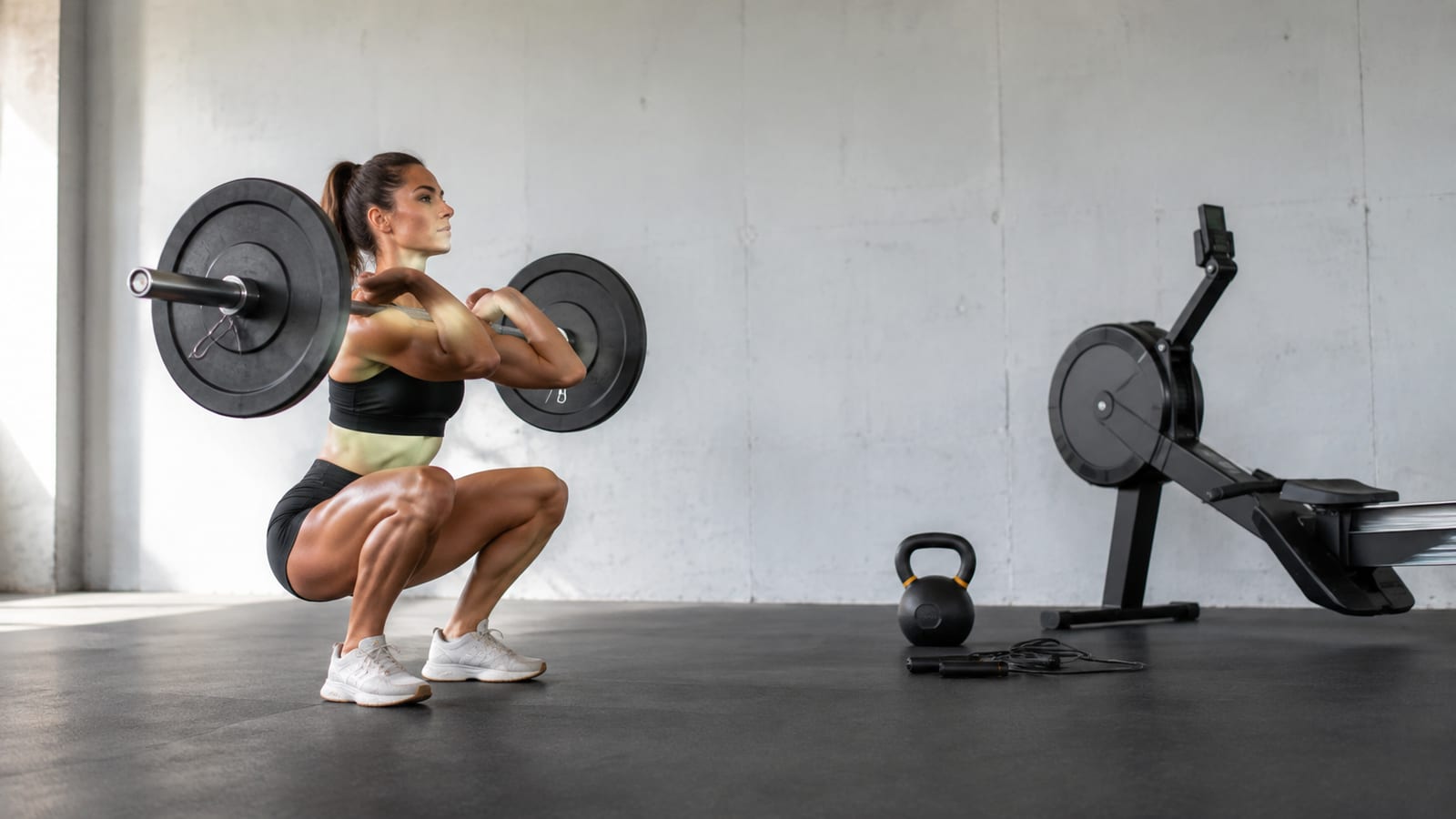
HIIT works best when you keep enough variables stable to measure improvement. Choose a movement, set a work-rest structure, and repeat it until your output improves.
Progress can mean:
- Producing more work during the hard efforts
- Keeping the same pace across every interval
- Using more resistance without losing technique
- Recovering faster during the easy periods
- Finishing the session without harming your next workout
Change one variable at a time. If you change the movement, resistance, interval length, and rest period together, your logbook can’t tell you what improved.
CrossFit progression is less tidy. The workout may change the movement, loading, order, time limit, and scoring method. A score gives you useful feedback, but unrelated workouts don’t provide the same clean comparison as a repeated lift or interval session.
CrossFit gyms may retest certain workouts and major lifts. Still, daily variation can hide the reason for a poor result. Your squat may feel weak because of leg fatigue, sore shoulders, poor sleep, or a demanding workout from the previous session.
Variety can keep you interested. It can also make weak points harder to diagnose.
Movement skill is the main dividing line
Simple HIIT lets you choose movements with a low learning cost. That matters because your conditioning should be limited by your effort and fitness, not by a complicated technique breakdown.
Useful HIIT choices include:
- Stationary bike intervals
- Rowing intervals
- Hill runs or hard hill walks
- Sled pushes
- Simple step-ups
- Low-complexity bodyweight circuits
A calisthenics HIIT plan can work at home. However, keep the exercises familiar enough that you can repeat quality reps as fatigue rises.
CrossFit uses a wider movement pool. You may see squats, deadlifts, presses, cleans, snatches, pull-ups, handstand work, box jumps, carries, rowing, and running during the same training week.
That range can improve coordination and general work capacity. It also creates more opportunities for technique to fail under pressure.
Olympic lifts require timing, balance, bar control, and a stable receiving position. Gymnastics movements require strength and control through the shoulder and trunk. A lighter load doesn’t remove the skill demand.
Use this test before adding speed:
- Can you repeat the movement without constant coaching?
- Does your range of motion stay consistent?
- Can you stop the set before technique changes?
- Do you know which muscle or skill is limiting you?
- Can you train again without joint pain affecting the next session?
If the answer is no, practise the movement away from the conditioning clock. Good reps come before more speed.
Which option builds strength and muscle?
Neither HIIT nor CrossFit replaces deliberate progressive strength training.
HIIT can improve your ability to produce and repeat hard efforts. The result depends on the movement you choose. Bike intervals improve bike fitness better than they build pull-up skill or barbell strength.
CrossFit exposes you to more tasks. You may improve your ability to switch between lifting, bodyweight work, and conditioning. That broader fitness has value if you enjoy it and can recover from it.
However, strength progression can be less predictable in CrossFit. The main lifts may compete with conditioning and skill work for time, energy, and recovery. You can still get stronger, but the program may not give a specific lift enough stable practice to beat the logbook consistently.
If muscle and strength are the priority, keep a clear progression model:
- Repeat your main lifts often enough to improve technique.
- Use consistent rep targets.
- Leave good reps in reserve on demanding compound lifts.
- Add weight or reps only after you earn the increase.
- Keep conditioning from reducing performance across several workouts.
For a lifter, HIIT is usually the cleaner addition. It gives you conditioning without turning every training day into a test of unrelated skills.
See the guide to combining CrossFit and weightlifting if you want both. The schedule has to protect your main goal, or the most exhausting part of the plan will take over.
The recovery trade-off matters more than the workout label
HIIT is easier to dose because you control the movement, intervals, and total work. You can reduce the pace, shorten the session, or choose a lower-impact exercise without changing the whole plan.
CrossFit is scalable for any fitness level. A coach can change the load, movement, range of motion, or workout volume. That makes CrossFit more accessible than its reputation suggests.
Scaling still requires judgment. A scaled workout can remain too demanding if it includes unfamiliar movements, high repetition, or too little rest. The label says “scaled.” Your joints get the final vote.
Use this recovery check after hard conditioning:
- Your next strength session still has repeatable technique.
- Your usual training loads don’t drop for several workouts.
- You can sleep and eat normally.
- Your joints feel ready for the next session.
- Your interval output stays steady instead of collapsing.
If conditioning keeps reducing your lifting performance, lower its dose. You don’t need to prove that you can survive a session. You need to recover and come back stronger.
Choose HIIT for control and efficiency
HIIT is the better fit if you:
- Have limited training time
- Already follow a lifting plan
- Want to improve conditioning
- Prefer familiar exercises
- Need clear progress markers
- Train alone or at home
- Want to control fatigue closely
A focused HIIT session can sit after lifting or on a separate day. Keep the movement simple and stop when the quality of the hard efforts drops sharply.
Do this first: choose one low-skill movement and repeat the same interval setup until your output improves. That gives you useful data instead of another random workout.
Choose CrossFit for coaching and variety
CrossFit is the better fit if you:
- Enjoy coached group training
- Want to learn more movement skills
- Prefer changing workouts
- Like measurable scores and competition
- Want broad fitness rather than one main performance goal
- Need a class schedule to stay consistent
The class environment can solve a real problem. Many people train harder and attend more often when a coach and group expect them to show up.
The trade-off is less control. You may not choose the movement, loading, or fatigue combination that appears that day. If your main goal is a specific lift, muscle group, or strength milestone, that can slow progress.
Read this CrossFit and traditional gym comparison before choosing based on branding or class atmosphere alone. The daily experience matters, but so does the work your plan leaves out.
Beginners should build control before intensity
Beginners can use either method, but neither should begin as a race.
For HIIT, start with movements you can perform smoothly. Keep the effort hard enough to count while preserving repeatable technique. A bike, rower, hill walk, or step-up is often easier to control than a complex lift.
For CrossFit, attend a class that teaches movement standards and scaling. Ask the coach how the session will be changed for a beginner. You should understand the movement before chasing the clock.
Avoid turning every workout into a test of toughness. Your first job is to build tolerance, learn useful patterns, and create a baseline you can beat.
If your reps look different from one interval to the next, adding speed only makes the mistake harder to fix.
How to combine HIIT with strength training
Place strength work first if strength or muscle is your main goal. Add HIIT after lifting or on a separate day, then watch how your next workout performs.
Keep the combination simple:
- Train your main strength movements with focused effort.
- Choose one low-skill HIIT movement.
- Keep the interval format stable for several sessions.
- Stop before output and technique fall apart.
- Reduce HIIT if your lifting, sleep, or joints worsen.
- Add work only after your current dose feels repeatable.
Don’t stack hard intervals beside your hardest leg session without a reason. Your plan has to fit your week, not just your motivation on Monday.
HIIT vs CrossFit: the practical verdict
Choose HIIT for efficient, trackable conditioning. Choose CrossFit for coaching, community, movement variety, and broad fitness.
For a natural lifter with limited time, simple HIIT alongside progressive strength training is the better starting point. CrossFit earns its place when you value the class structure and skill practice enough to accept less predictable fatigue.
Both can work. The better choice is the one you can perform with good technique, recover from, and repeat for months.
FAQ
Can HIIT and CrossFit be done in the same week?
Yes, but keep the total hard conditioning manageable. If CrossFit already includes demanding intervals, adding separate HIIT may reduce your lifting performance. Track how your next strength session feels before adding more work.
Is CrossFit better than HIIT for weight loss?
Neither method has a special claim on fat loss. Results depend on your overall activity, food intake, recovery, and consistency. Choose the format you’ll perform regularly without compensating by becoming less active afterward.
Can you do HIIT without equipment?
Yes. Hill walks, running intervals, step-ups, and simple bodyweight movements can all work. Pick an exercise that lets you repeat the hard efforts without losing control of your joints or technique.
Should you do HIIT before or after lifting?
Do lifting first if strength or muscle is your priority. Perform HIIT afterward or on another day so fatigue doesn’t reduce your productive strength sets.
Is CrossFit safe for beginners?
CrossFit can be appropriate for beginners if the coach scales the movement and teaches the technique before adding speed. Skip any class that treats poor form as a badge of effort. Your joints and recovery determine the right workload.