
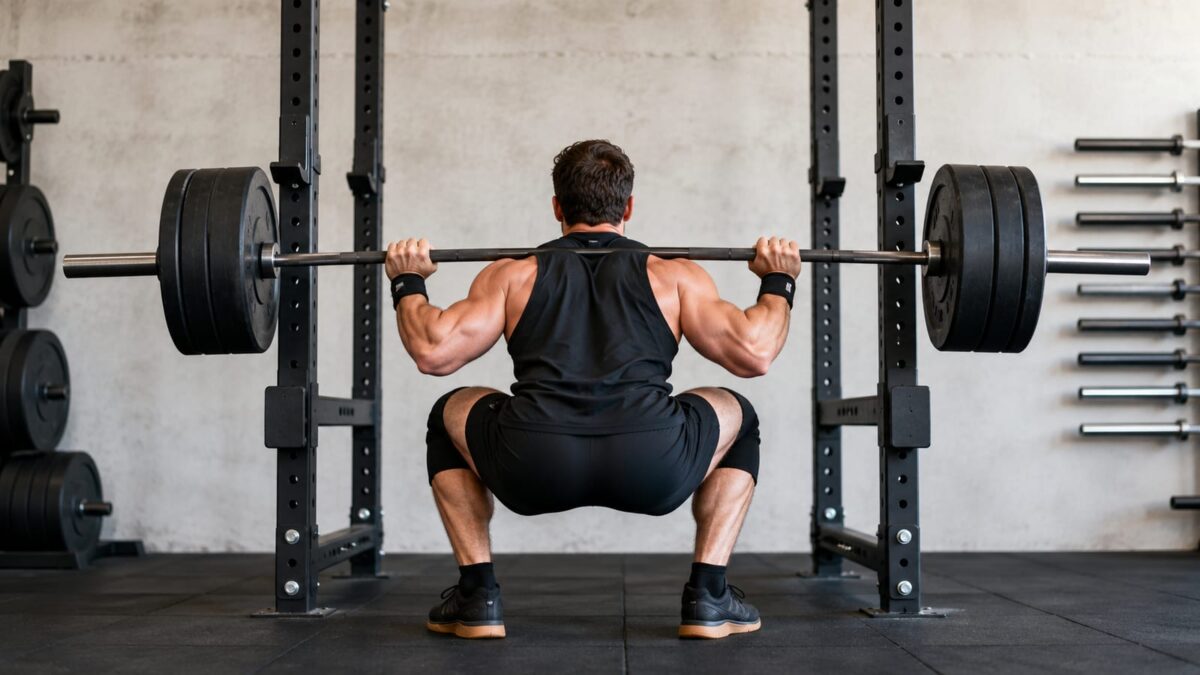
3X5 or 5X5: Which Strength Plan Fits You Best?

 1
1
 0
0 Start with 3×5. For most natural lifters with a job, a commute, and finite recovery, three hard sets of five gives you nearly all the strength progress of 5×5 at a fraction of the fatigue cost. The difference between the two is not philosophical. It's two extra sets you have to recover from, week after week, on top of the ones already doing the work. Earn those sets before you add them.
Last updated: 2026-08-07
What actually separates the two schemes
Both are straight sets: same weight, same reps, every set. You squat a challenging weight for five, rack it, rest, repeat. 3×5 means three of those. 5×5 means five.
That's it. No different rep range, no different adaptation. Anyone selling you a deeper distinction is padding a word count.
Because the weight stays the same across sets, both reward careful loading. Pick too heavy and the final set collapses. Pick too light and nothing happens. For the wider context on fixed loading, the difference between pyramid sets and straight sets is worth your time.
Why three sets wins for most busy lifters
Three sets fit in your week. Five sets fit in a program written for someone with more sleep than you have.
A 3×5 session on three main lifts fits into a manageable training window with honest rest periods. Add two sets to each lift and the workout gets much longer. Most of that extra time is spent waiting to feel ready. Meanwhile, the extra work lands mostly on your recovery budget, not your logbook.
The research on set volume is less dramatic than gym forums suggest. A meta-regression on single versus multiple sets reported an effect size of 0.26 for strength. That's real, and it justifies doing more than one set. It does not justify assuming five beats three by the same margin.
So the honest framing is this: more sets help, with diminishing returns, and only if you recover. Three sets is comfortably past the point where the big returns live.
How much extra work does 5×5 really add?
Ten more reps per lift, per session. On a three-lift day, that's thirty more reps at heavy loads.
| 3×5 | 5×5 | |
|---|---|---|
| Working sets per lift | 3 | 5 |
| Reps per lift | 15 | 25 |
| Reps per 3-lift session | 45 | 75 |
| Rough session length | Shorter | Much longer |
| Weekly hard sets per pattern (3x/wk) | 9 | 15 |
Across a week of three full-body sessions, that's six extra hard sets per movement pattern. Not trivial. For a lifter eating enough and sleeping well, it can be productive volume. For everyone else, it's accumulated fatigue that eventually shows up as a stalled squat.
Volume only counts when you recover from it. Otherwise you're logging work, not progress.
Does fewer sets let you lift heavier?
Yes, and this is the strongest practical argument for the shorter scheme. Your top load is limited by the worst set you have to complete, not the first one.
If you have to hit five sets, you pick a weight you can still move on set five. If you only owe three, you can pick a weight that's genuinely hard on set one and still clean on set three. That's why 5×5 programs typically use 75 to 80 percent of your one-rep max. Sheiko programs often prescribe around 80 percent for 3×5 work.
Heavier bar, same technique, fewer chances to get sloppy. Bar speed stays honest. Set five of a hard 5×5 is often a grinding, rounded lift that barely resembles set one, and your body learns whatever you practice most.
None of this is permission to load a bar you can't control. Heavier means heavier with the same movement, not heavier with a wider stance and a bounce.
Is one for strength and the other for size?
Mostly a myth, but there's a kernel in it. Strength is a skill built on heavy, clean, repeatable reps, and three sets gives you those at higher intensity. Muscle responds to hard sets and enough food, and five sets delivers more of them.
The hypertrophy data is thinner than the strength data. One analysis reported an effect size of 0.10 plus or minus 0.04 for muscle growth. Another found 40 percent greater hypertrophy-related effect sizes with multiple sets. Meaningful, not miraculous.
Here's the practical point. If muscle is your goal, fives are a poor tool for the job regardless of set count. You'd get more growth adding moderate-rep accessory work than adding two more heavy sets. Barbell strength work in the five-rep range is the foundation. Hypertrophy comes from the rep ranges built for it stacked on top.
What a three-set workout looks like
Keep it to four or five movements. Use a full-body layout three times a week, alternating two days:
Day A
- Back squat – 3×5
- Bench press – 3×5
- Barbell row – 3×5
- Curls or face pulls – 2 sets of 10-15
Day B
- Deadlift – 1×5 (one heavy set is plenty)
- Overhead press – 3×5
- Chin-ups – 3 sets of 5-8
- Triceps or hamstring work – 2 sets of 10-15
Run A-B-A one week, B-A-B the next. That's the classic three-day full-body structure, and it holds up because it fits real calendars.
Deadlifts get one work set for a reason. Three heavy sets of five deadlifts is a fatigue bill you'll pay at your next session.
How the progression works
Add the smallest practical jump once you complete all three sets of five with clean technique. Use a smaller increase on upper-body lifts and a slightly larger one on lower-body lifts. Fractional plates help when standard jumps are too much.
The standard is not "I finished the reps." It's "I finished the reps and the last one looked like the first one." If rep five of set three is a different movement than rep one of set one, hold the weight another session.
When you miss reps in consecutive sessions, that's a stall. Reduce the load modestly and build back. If the same lift keeps stalling, you need a deload, more food, or more sleep. Usually it's one of the last two.
Small increases add up. Still, progress will slow long before simple arithmetic produces a heroic yearly total. That's why you take small jumps instead of forcing big ones.
Rest periods for heavy fives
Take several minutes between work sets on squats, deadlifts, presses, and rows. Shorter rest is a compromise, especially once the weights get hard.
Cutting rest on heavy compounds doesn't make you tougher. It makes set three lighter than it should have been. You're training a strength skill, and skill practice needs you fresh enough to perform.
This is a hidden cost of five sets that rarely appears on the program page. Honest rest periods turn the session into a long one. Most people then trim rest to survive the clock, which erases the volume advantage they added the sets for.
Accessory work is different. Shorter rest is fine on curls.
Where the fatigue actually lands

Heavy fives cost you in three places, and they recover on different timelines.
- Local muscle fatigue. Recovers fastest. Usually gone before the next session.
- Systemic and nervous-system fatigue. Accumulates quietly. Shows up as poor bar speed, low motivation, and lifts that feel heavy at loads you handled last week.
- Joints and connective tissue. The slowest to adapt and the least forgiving. Elbows, knees, and lower backs don't care that your muscles feel fine.
Your joints get a vote. Going from three heavy sets to five is a meaningful jump in cumulative loading, and connective tissue adapts more slowly than muscle.
Form breakdown is a stop sign, not a challenge. If your knees cave or your back rounds on the last rep, that set ended one rep ago. This is the same logic behind a deliberately low-volume approach to training: do the work you can repeat, not the work that looks impressive once.
When 5×5 is the right call
Run it as a temporary block, not a default. Specific cases where it makes sense:
- You're a beginner, loads are still light, and the extra sets buy you technique practice cheaply.
- You're in a genuine surplus, sleeping well, and your schedule can absorb longer sessions for a focused block.
- You've stalled at the same weight for several weeks and everything else, including food, sleep, and effort, is already handled.
Notice what all three share: you can afford it. Five sets isn't the more serious program. It's the more expensive one.
If you're picking between plans generally, the right workout split matters more than the set count you write next to each lift.
Neither plan builds endurance
Sets of five with long rests train maximal strength. That is not muscular endurance, and adding sets won't convert one into the other.
If you want work capacity, add it separately. Put a few conditioning sessions on non-lifting days or after your barbell work, never before it. Sled pushes, bike intervals, and brisk incline walking all work.
Don't try to make your squats do cardio's job. You'll get worse squats and mediocre conditioning.
So which one should you run?
Start with 3×5. Run it long enough to establish steady progress, log every session, and add the smallest weight jump you can whenever all three sets come in clean.
Move to 5×5 only when you've earned it: consistent progress, no lingering joint complaints, enough food, and a schedule with room for the longer session. Then run it for a block and go back.
Technique is the constraint that doesn't move. Everything else, including sets, load, rest, and frequency, is negotiable around it.
FAQ
Can I do 3×5 and 5×5 in the same program?
Yes, and it's often smarter than picking one. Use five sets on a lift you want more practice with, such as the overhead press. Keep three sets on the lifts that cost you the most to recover from, usually squats and deadlifts.
What percentage of my max should I use for each?
For 5×5, start within the usual 75 to 80 percent range and adjust down if needed. For 3×5, choose a load that leaves every rep clean across all three sets. Sheiko programs often use about 80 percent, but that prescription does not apply to every plan.
How long before I stop making progress on 3×5?
Untrained lifters often add weight every session for an initial stretch. Intermediates usually need slower increases. Once repeated stalls continue despite sound food, sleep, and technique, change the rep range rather than fighting the same weight.
Should I do 3×5 if I've never touched a barbell?
Learn the movement pattern with light weight first, using higher reps to get repetitions in. Once your technique holds up under a moderate load, fives are an excellent way to build a base. Just don't start heavy because the program says five reps.
Does 3×5 work for machines and dumbbells?
It works, but it's a poor use of them. Machines and dumbbells suit moderate-rep work where you can push closer to failure safely. Save low-rep work for barbell lifts where load progression is easy to measure.